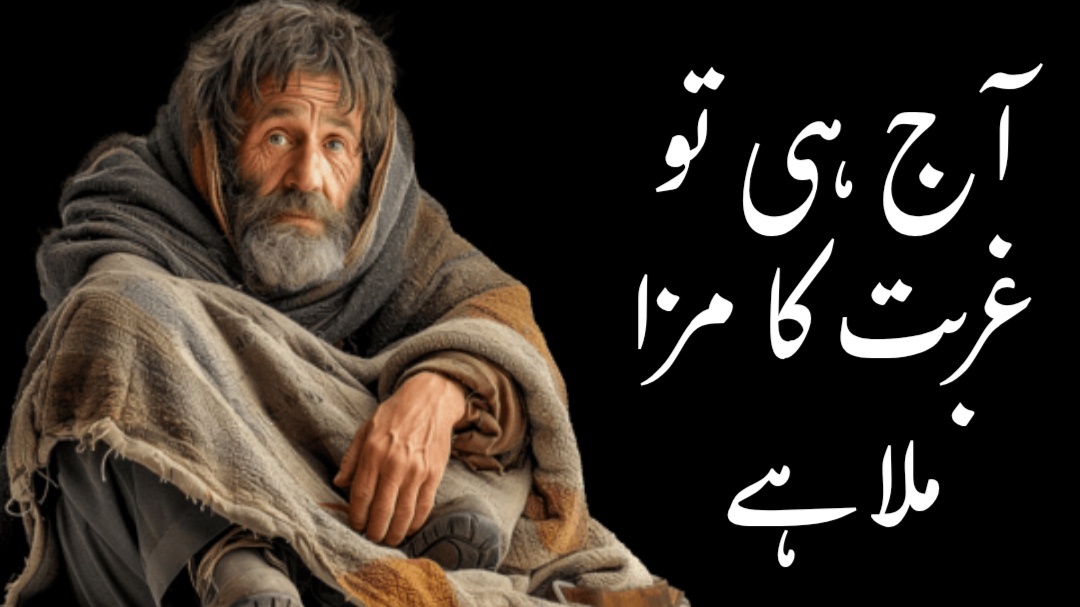
Only Today Have I Experienced the True Essence of Poverty

There once lived a poor barber in a village who used to cut people's hair and shave their beards under a tree, setting up a single chair. He was barely making ends meet. He had no house to live in, no wife, and no children. His entire worldly possession consisted of just a single sheet and a pillow. When night fell, he would spread his sheet outside a closed school, place his pillow, and go to sleep. One morning, a sudden flood struck the village. When he woke up, there was chaos and commotion everywhere. He got up and climbed onto the water tank built next to the school. There, he spread his sheet, leaned his pillow against the wall, lay down, and began watching the people. People were running for their lives, carrying their belongings and valuable household items; some were fleeing with cash, some with jewelry, some with their goats, and others with whatever precious assets they could grab. In the midst of this panic, a man came running by, carrying gold jewelry, money, and clothes. When he passed by the barber and saw him lying down so peacefully, he snapped in anger: "Hey! All our belongings have been ruined, our lives are at stake here, and you are lying there fast asleep with your legs stretched out!" Hearing this, the barber calmly replied: "Sir, only today have I experienced the true essence of poverty!" When I heard this story, I laughed at first, but then a profound thought crossed my mind—perhaps the scene on the Day of Judgment will be quite similar. When accountability is taken from all mankind, on one side, the account of the poor will be audited: just their two meals a day, their clothes, the rights of Allah, and the rights of humanity. On the other side, the account of the rich will be audited: their plazas, shops, factories, vehicles, bungalows, gold, jewelry, servants, accumulated wealth, lawful and unlawful earnings, luxuries, comforts, Zakat, the rights of Allah, and the rights of humanity. While giving account for so many possessions, the rich will be drenched in sweat and trembling out of absolute fear. At that moment, perhaps like that barber, the poor will be looking at these rich individuals with a strange sense of peace on their faces, and perhaps saying deep down in their hearts: "Only today have I experienced the true essence of poverty." We pray to Allah Almighty to grant us the ability to be grateful for every single blessing, and to give us the guidance to use and distribute it according to His divine will. Ameen, O Lord of the Worlds! (Narrated — Selection: Islamic Tube Pro App)

ارے بھائی!

اگر آپ ہزاروں کتابیں، نعتیں، تصاویر، ویڈیوز، اخبار، مضامین، قبلہ نما، اوقات نماز، اسلامک گھڑی اور بہت کچھ آسانی کے ساتھ حاصل کرنا چاہتے ہیں تو بس ہمارے Islamic Tube ایپ کو پلے سٹور سے انسٹال کرو، اور بالکل مفت اور آسانی کے ساتھ اسلامک مواد حاصل کرو

ڈاؤن لوڈ کریں
Image 1

The Prophet's ﷺ Wise Method of Guidance and Training

The Prophet's ﷺ Wise Method of Guidance and Training

One method of the Prophet's (PBUH) training was that he would first make a person realize their mistake, and then offer advice. Once, he was sitting in a gathering of the noble Companions (R.A) when a young man entered the mosque and started looking around as if searching for someone. Spotting the Messenger of Allah (PBUH), he came towards him and said, "O Messenger of Allah! Grant me permission to commit adultery (zina)." Consider how immense his audacity was! But thousands of lives be sacrificed for the Teacher of Humanity (PBUH) that not even the slightest sign of anger appeared on him. Had it been a mentor of today's era in his place, who knows what they would have done. Upon hearing this kind of question from the youth, the Prophet (PBUH) perceived his spiritual condition—that he was a weak youth in terms of faith, yet the faith remaining within him prompted him to seek permission [rather than committing it secretly]. He did not give an immediate lecture to the youth, but rather first made him realize his mistake. Thus, the Prophet (PBUH) asked the young man, "Would you like someone to commit adultery with your mother?" He replied, "No." The Prophet (PBUH) said, "In the same way, other people do not like it for their mothers either." Then he asked, "Would you like it for your daughter?" The youth replied, "No." The Prophet (PBUH) said, "Other people also do not like it for their daughters." The Prophet (PBUH) asked again, "Would you like it for your wife or your maternal aunt?" He replied, "No." Finally, the Prophet (PBUH) said, "Desire for people what you desire for yourself." The purpose of such questions was to make him realize his mistake. When the youth understood his error, the Prophet (PBUH) placed his hand on his chest and prayed, "O Allah, guide his heart, forgive his sin, and guard his chastity." The young man walked out of the mosque saying, "By Allah, when I came to the Messenger of Allah (PBUH), nothing was dearer to me than adultery, and now the state is such that nothing is more hateful to me than adultery." (Musnad Ahmad, Hadith No. 21708) ___________📝📝___________ Book: Existing Circumstances Mein Seerat-e-Rasool (PBUH) Ka Paigham Page No: 258 - 258 Approved by: Hazrat Maulana Peer Zulfiqar Ahmad Naqshbandi Selection: Islamic Tube Pro App